When going into this course, I didn’t have much knowledge of the DCIM minor, which was the only reason I was taking the course, so I wasn’t really sure what I was going to be learning about. In the beginning, it was mostly just discussion questions about stuff I had no knowledge about, but after coming out of the course I learned a great deal about the difference of platforms I could use to get information across.
The first thing I took away from this course was to always keep in mind of an audience when promoting anything for a cause of project. I think that for all of the posts and projects that were required, I always had to make sure that I was keeping the targeted audience in mind in terms of language, content, and doing things that would make them want to come back to my page, whether YouTube, SoundCloud, or WordPress. Especially when working on the PSA and podcast, I really found that I loved creating content through audio, because it’s something that’s in my element. By keeping topics interesting and providing links and calls to action to the audience were my biggest take away on this aspect of creating any kind of content.
Another thing I took away from this course is about
music loudness and fidelity, and how it comes into play when producing
different genres of music. Music production is something that’s extremely
interesting to me, and I think that it was really interesting to understand the
concepts that go into creating this kind of content. In my opinion, I think
that fidelity is a lot more important over loudness, but I do think that
loudness is necessary for some genres of music. When I produce my own music, I
tend to think more about the overall fidelity of the song.
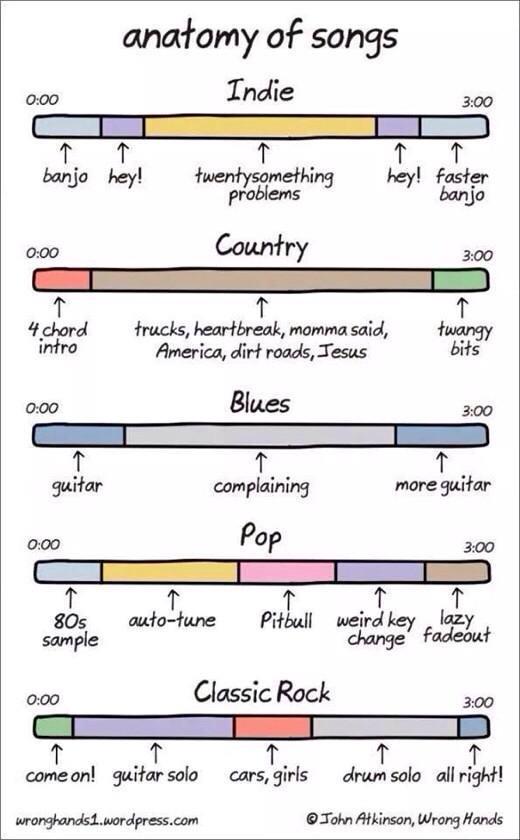
In the meme below, the anatomy of songs is shown in a comical manner. Since my website focuses on music in all of its aspects, this meme shows the “anatomy” of different genre’s of music. I think this meme comically relates to when we talked about the fidelity and loudness of certain genre’s of music and the production that goes into creating them.
“Anatomy of Songs” photo by Vodka Dispenser. All rights reserved.
Davison (2012) defines the ideal as “the concept or idea conveyed” (Davison 2012, pp. 123). The ideal behind this meme is to show that there are different and generic ways that songs are created based on their genre of music — and it just so happens that a lot of the songs have the same things. The behavior behind the meme was someone using a software to create a drawing, to make the idea of genre music funny. It’s manifestation, originated from a wordpress site (just like this one), and made its way around from that website.
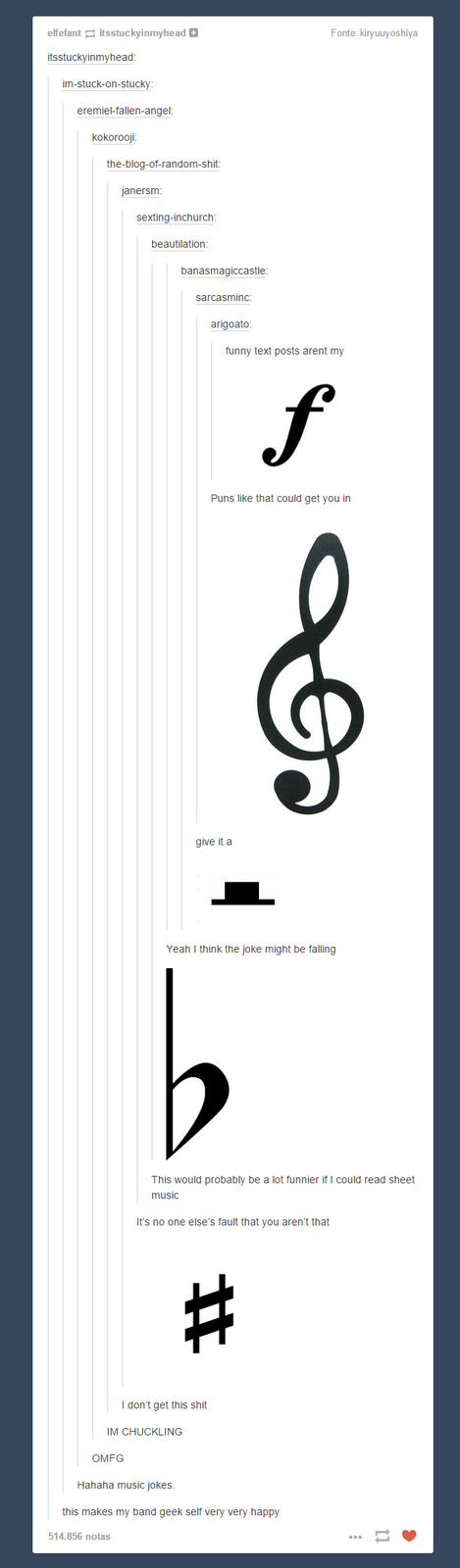
In this meme (below), is a joke that people that know a little bit of music theory would know about. However, if you know music, the joke is actually pretty funny. For those who don’t get what the symbols mean: it’s saying “funny test posts aren’t my forte, puns like that could get you in treble (like trouble), give it a rest, yeah I think the joke might be falling flat, this would probably be a lot funnier if I could read sheet music, it’s no one else’s fault that you aren’t that sharp.” For music lovers, which my audience consists of, this plethora of puns is hilarious. The meme actually comes from Tumblr, which is a platform we discussed in class as one of the earlier forms microblogging.
“Music Puns” photo by ”half-moon” bubba. All rights reserved.
The ideal of this meme (above) was to have a conversation using puns or symbols in the language of music. I think that it was intended to show some exclusivity for the music community and at the same time showing humor in something that’s actually really technical and hard to understand. The behaviors of this meme originate from Tumblr comments, which was then manifested by someone who probably thought it was funny, and made its way to other social media platforms. The manifestation is interesting in this case, because it made its way around in a natural manner which was more coincidental opposed to the creations of a lot of other means which are usually intentional.
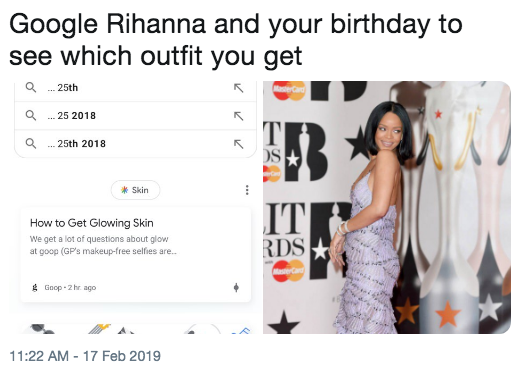
This meme (below) is referencing Rihanna who is a pretty famous female artist in the music industry. Since my website focuses on female artists, I think this meme supports that idea very well. As far as what we discussed in class, we wen’t over the top 10 songs at one point, and none of them were female. Being that Rihanna is one of the most famous artists, period, I think she represents a huge part of the music industry.
“Google Rihanna and Your Birthday” photo by Baby Spice. All rights reserved.
Women in Music strives to support local women interested in the music industry, so If you know of any other local artists that you might want to help exploit, again you can start your own local chapter at the nonprofit website.
In this podcast, you will encounter three on the rise female artists who are from the state of New Jersey! Through explaining each of the artists of the podcast, I discuss a little bit about each of their basic info (genre of music, age, real name, and place of origin), then play a small excerpt from one of their more popular songs, and talk more about some of their future plans and available streams so that you can see the talent of the artists you could potentially start supporting. Hopefully this will convince you to stream their music on the various links provided in the description area. The three artists and songs I show in the podcast are:
We need your support. Women in Music is the industry’s leading non-profit working toward gender equality.. Support our cause by starting your own local chapter at www.womeninmusic.org to provide events, network opportunities, and educational resources in your local town. Help create an equal opportunity for everyone with a passion for music.
Do you know the stats? The WIM website provides educational statistics about the major gender inequalities within the music industry:
70/30
The gender divide across all regions is roughly 70% male to 30% female.
15%
15% of label members are majority owned-by women. (US) -A2IM
6%
6% of recognized producers are women. (US & Canada) – WIM Canada
7%
7% of women identify as having a role within sales/biz dev. (Canada) – WIM Canada
50%
50% of freelance women earn less than £10,000 annually. (UK) – HM Revenue & Customs
16%
16% of PRS members are women (UK) – PRS
20%
Across the participating countries’ collecting societies, women represent 20% or less of registered composers and songwriters (Europe) – Keychange
12%
12% of JACAP members are women. (Jamaica) – JACAP
19%
19% of COSCAP members are women (Barbados) – COSCAP
22%
22% of all performers across the 600 most popular songs from 2012 to 2017 were female. – USC Annenberg Inclusion Initiative
12%
12% of songwriters of the 600 most popular songs from 2012 to 2017 were women. – USC Annenberg Inclusion Initiative
How to maintain your posture and breathing is an important basic to learn about before even approaching a vocal warm up! In order to prepare your voice, you must prepare your body first and that includes having the perfect posture, and knowing the right way to breathe. I know it sounds silly, but once you watch my tutorial and pick up the shown techniques, you’ll realize a significant difference in the quality of your voice. In this video, you’ll be approaching two types of healthy techniques in singing: Posture and Breathing. When your body is your instrument, you can never go wrong with being a perfectionist when it comes to keeping it in tip-top shape!
So when it comes to executing the perfect posture, you wanna make sure you have the best possible alignment — how straight you are from your head to your feet — so that you can have the right amount of balance and structure for quality control and sound. I got through this step by step by addressing the feet, knees, hips, chest/shoulders, and head. Once you’ve nailed that part down, breathing should come extremely easily. And for all my singers who feel themselves running out of breath too quickly, following how I breath in the video, and using the helpful diagram as guides, nailing this technique should be a piece of cake, and running out of breath and control will no longer be an issue!
Christine T. Wolf (2016) explains how Web 2.0 platforms, like YouTube, shows content “often displayed by way of “recommended” or “trending” content, a hallmark of Web 2.0 platforms today is their ability to shape notions of “relevance” by algorithmic sorting and customization” (Wolf 2016). I believe that my video will be seen through the “recommended” algorithm of YouTube. There is a ton of vocal technique videos on YouTube, and I think that people that like to visualize how to do things will come across my video and learn from it. As a result of this, my audience will continue to present themselves in a way they want through singing as Wolf (2016) also states in their article.
“At the same time Web 2.0 platforms are creating the markets they then exploit, they are also shaping who users are and might become by dramatically tailoring the information they are exposed to” (Wolf 2016).
Wolf, C. T. (2016). DIY videos on YouTube: Identity and possibility in the age of algorithms. First Monday,21(6). doi:10.5210/fm.v21i6.6787
I think many of us have seen the differences of how men and women are treated in the music industry. From forcing rivalry on the few women rappers, Cardi B and Nicki Minaj, to ridiculing SZA for her reclaiming of the word “side-hoe”, women get the short end of the stick when it comes to expressing their experiences. In Jane Bowers book, Women Making Music, she discusses the lack of musical impact that women got credit for due to neglect and inconsideration of societal and class stats. In fact, she explained that “Musicologists have paid little attention to the sociology of music” (Bowers & Tick 1986). This lack of attention to the important aspects of what gets women into music in the first place, is the reason why women in our modern day in age need to make a credited impact that women in history have been silenced for.
However, years may have passed, but the bad treatment of women still remains unresolved. In a study titled Inclusion in the Recording Studio? done by the USC Annenberg Inclusion Initiative, women were found to be overly under-appreciated in our modern day society. Dated only two years ago, this study found that “A total of 1,239 artists were attached to the 600 top songs. In 2017, a full 83.2% of artists were men and only 16.8% were women. This calculates into a gender ratio of 4.9 male artists to every 1 female artist”(Smith, Chouetiti & Pieper 2018). That’s almost FIVE men to every woman’s song that made it into the top 600 songs. It’s not that women are incapable of achieving this goal, it’s the harsh reality that women are just perceived in a way that society nonchalantly overlooks.
“Expression” (CC BY 2.0) by Erica Cha, Pixlr.
That being said, music is widely known to be the ultimate universal language. It possesses an emotional, unspoken, therapeutic ability that sometimes surpasses even the most credible form of psychological verbal medicine. Women suffer through a multiplicity of emotional stress, whether thats through race, sexuality, or any other circumstantial factors. These emotional stressors work as fuel for a musicians musical inspiration through their instrumentals, lyrics, and overall sound. Women with musical talent need to take advantage of this. In Stefan Koelsch’s article, Brain Correlates of Music-Evoked Emotions, he discusses the emotional de-stressing that music provides for the human brain: “the hippocampus is involved in music-evoked positive emotions that have endocrine effects associated with a reduction of emotional stress, such as lower cortisol level”(Koelsch 2014). The overall essence of that statement is saying that music helps with emotional stress. And the best way for aspiring women artists to do that is to express their struggles through their music, and at the same time, create something even more beautiful and relatable in the process.
References
Bowers, J. M., & Tick, J. (1987). Women making music: The Western art tradition, 1150-1950. Urbana: University of Illinois Press. tradition, 1150-1950. Urbana: University of Illinois Press. University of Illinois Press.tradition, 1150-1950. Urbana: University of Illinois Press. University of Illinois Press.
Koelsch, S. (2015). Music-evoked emotions: Principles, brain correlates, and implications for therapy. Annals of the New York Academy of Sciences,1337(1), 193-201. doi:10.1111/nyas.12684A
Think about your favorite song. One that you can connect to more than anything else. Whether it’s the lyrics, the sound, or just the way it makes you feel, you probably asked yourself something that we’ve all experienced when hearing something that amazing: how is it possible that someone can be that talented? There’s a handful of people that have the capabilities of transforming their most personal thoughts and perspectives through the expression of music. It’s a creative outlet, something that emulates every kind of passion, emotion, expression, and individuality
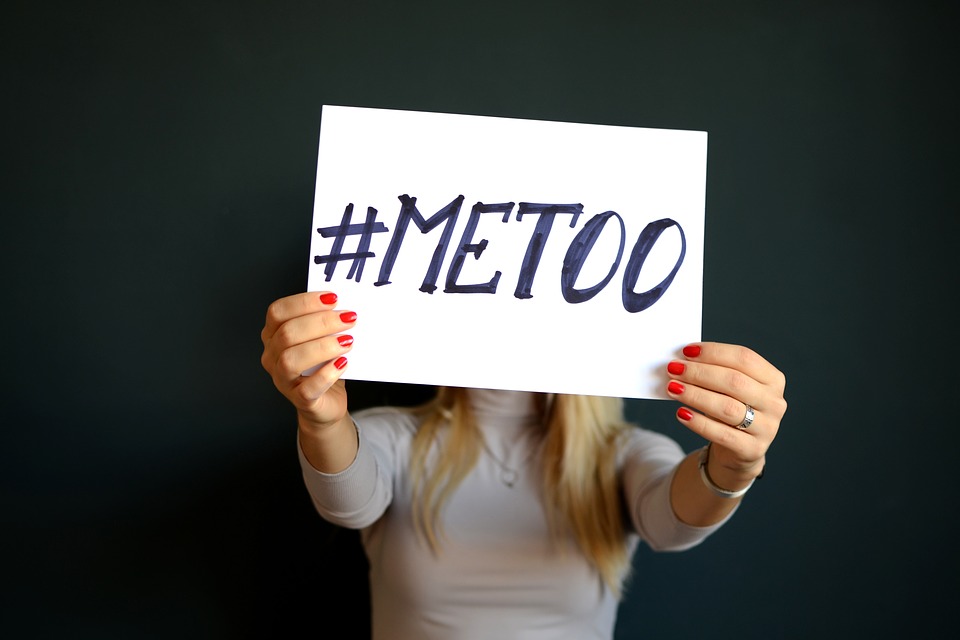
“Me too” by Mihai Surdu, Pixabay is licensed under CC BY 2.0
Founded in 1985, Women in Music was created to break down barriers of inequalities, and bring more awareness to the importance and significance of women in the music industry through its many platforms, and determined staff.
When someone has such a great passion and talent for creating that kind of needed outlet, it must be supported and valued. However, when it comes to the industry, a lot of women struggle during their uprise. Whether it’s because of financial instability or unequal opportunity, female musicians have trouble getting to the platform that they need to reach in order to fulfill their potential of passion and creativity for the thing they love most: making music. And that’s why Women in Music’s mission is to promote female musicians on the inside, outside, and in the future of the industry. Not only is the staff created of powerful women already working within the industry, but it is also their motive to help female musicians get the recognition they deserve. This includes, promotions on our social media outlets, and acknowledging and providing events for the young musicians who want to strive in the industry. The Music industry is an amazing opportunity for women to strive in, and it’s WIM’s job to make existing ones thrive, and future ones succeed.



 WOMEN IN MUSIC